Kruja and the Skanderbeg Museum – the heart of Albanian history
Year of Skanderbeg – tribute to the national hero
From the series of optional tours for Poles, in Polish, with a Polish guide, from Durres, Golem and Mali Robit. In 2018, the Prime Minister of Albania, Edi Rama, declared the Year of Skanderbeg in honor of the 550th anniversary of his death. Skanderbeg is Albania’s greatest national hero, which is why I’m writing about him today and about the museum dedicated to his memory.
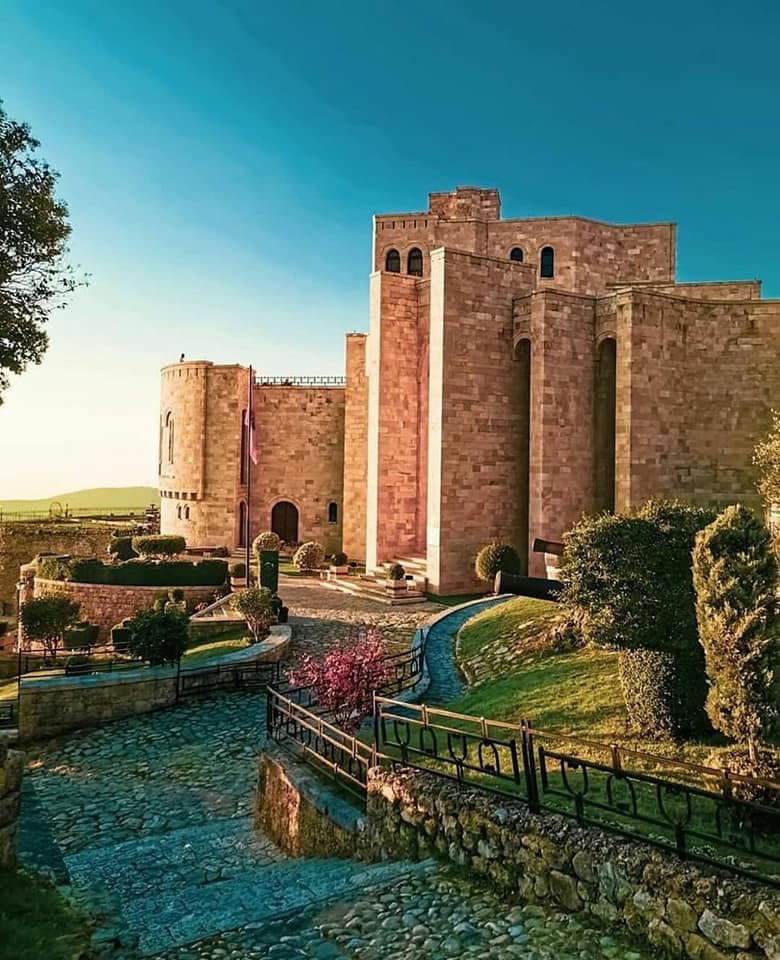
Skanderbeg Museum in Kruja – a place full of history
The museum dedicated to George Kastrioti Skanderbeg (Gjergj Kastrioti Skënderbeu, 1405-1468) is located in the city of Kruja and is one of Albania’s most popular attractions. It was opened in 1982 next to the old castle and was designed by Pranvera Hoxha, daughter of former dictator Enver Hoxha. Enver Hoxha did not appear at the opening as he did not fully approve of the museum’s architecture.
History and exhibits – a journey through the centuries
The museum has several floors, and the exhibits show events in chronological order. The building connects to the old castle in Kruja, which was once the capital of the Albanian principality of Arber. This principality lost the fight against the Ottoman Turks three times in the 15th century. In the museum, you can see many original items – military artifacts, documents, biographies, and reproductions that detail the history of Albania in the Middle Ages.
Visitors tour rooms with exhibits from antiquity, medieval castles, Albanian principalities, Turkish invasions, as well as rooms dedicated to the resistance movement, Skanderbeg’s chancellery, library, princes’ hall, and national heritage. There are also original icons, figures, and objects made of bronze, iron, and copper. Of particular note are a bell from 1462 and swords from the 15th century.
Skanderbeg – the hero who stopped the Turks
For 25 years, Skanderbeg defeated the Ottoman armies three times, making Albania an unconquerable obstacle for Turkey and halting the Ottoman expansion in Europe. For these merits, he was called the “Warrior of Christ”. Pope Pius II awarded him the highest decoration and appointed him commander of the Crusader armies.
Skanderbeg – one of the greatest strategists in history
Historians place Skanderbeg among the four greatest commanders and strategists of all time – alongside Julius Caesar, Alexander the Great, and Napoleon Bonaparte. His army defeated as many as 20 enemy armies, and he himself was said to have killed about 3,000 opponents. Sources say he was powerfully built and extremely strong, which is confirmed by the weight of his sword, which was too heavy for the average warrior.
Assassination attempts and Skanderbeg’s symbolism
There were multiple attempts to poison Skanderbeg, and during the Venetian war, a reward of 100 ducats per month was even offered for his killing. His faithful symbol was a horse that no one but him ever rode.
Skanderbeg’s portrait and worldwide recognition
In 1466, the Italian painter Gentile Bellini painted a portrait of Skanderbeg commissioned by the Venetian authorities. Today, main squares in many cities are named after him, including in Tirana, Pristina, Zurich, Warsaw, Rome, Paris, Chicago, and Skopje.
Encouragement to visit the museum in Kruja
When in Kruja, it’s worth visiting the Skanderbeg Museum to feel the spirit of Albanian history and learn about the fate of one of the Balkans’ greatest heroes.
